aCAPTCHA: Verifying That an Entity Is a Capable Agent via Asymmetric Hardness
Zuyao Xu, Xiang Li, Fubin Wu, Yuqi Qiu, Lu Sun, Fasheng Miao
An entity-type verification protocol for admitting capable AI agents.
A different verification question
aCAPTCHA asks whether an interacting entity is a capable AI agent. It separates entity-type verification from checking an entity’s identity, and studies humans, scripts, and agents as distinct classes.
Asymmetric hardness
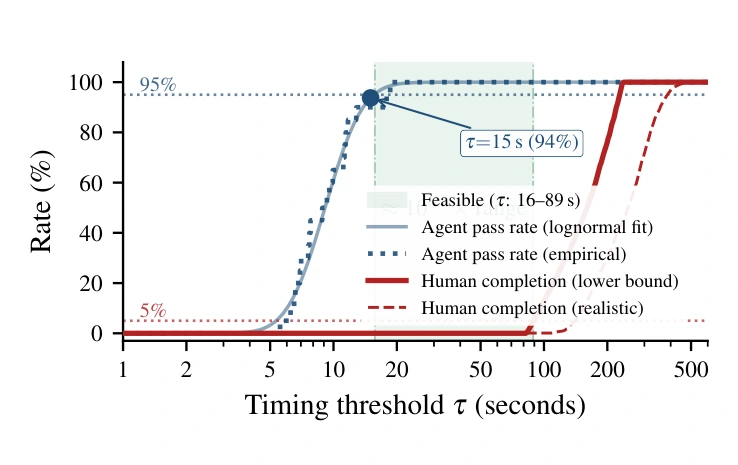
The protocol combines action, reasoning, and memory requirements with a time limit. Its HTTP-based challenges use differences in human and model processing time to study an agent-admission mechanism.
Evaluation scope
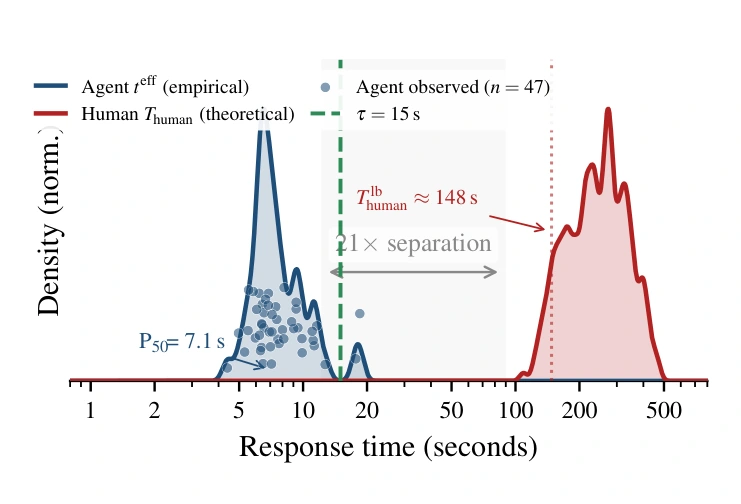
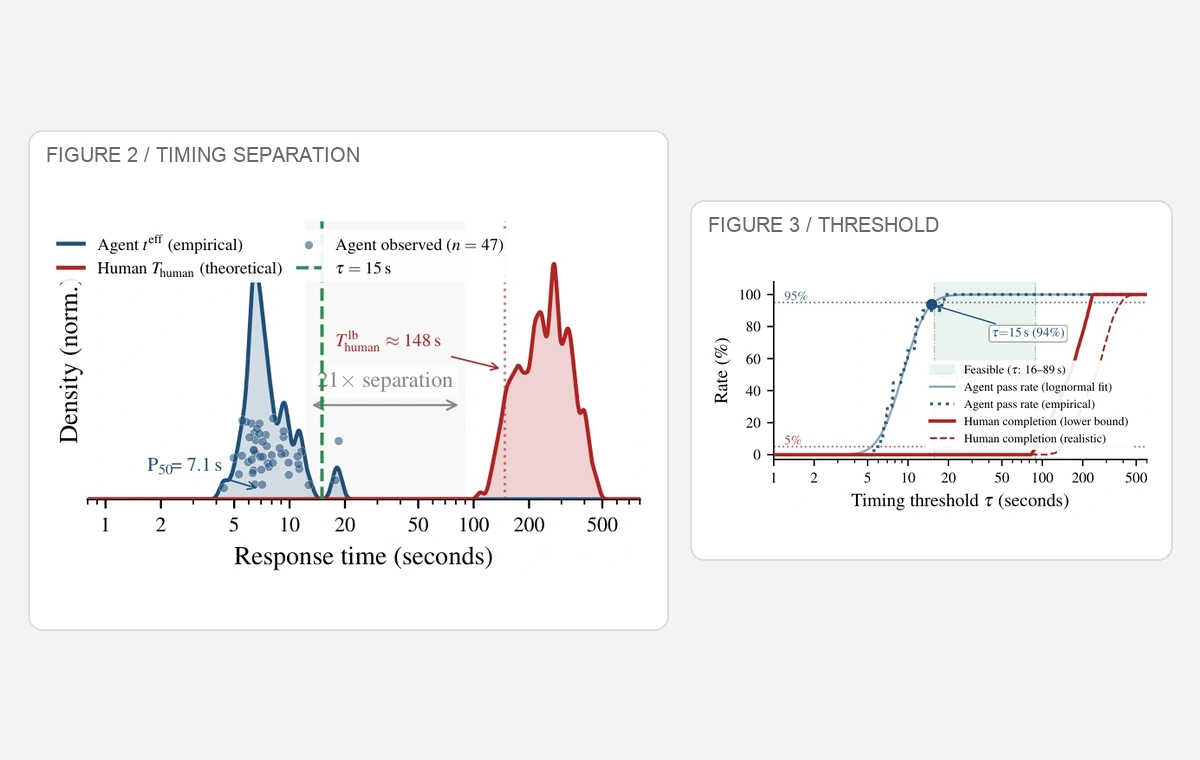
The paper reports preliminary agent trials alongside modeled human timing. The figure distinguishes empirical agent observations from simulated human response times; it should not be read as a completed human-subject experiment.
More figures